Every few months, a new AI tool goes viral, and people start worrying again—“Is my job next?”
It’s a real fear. I’ve seen friends panic after seeing AI write emails, design logos, and even take customer support calls. One of them works in data entry and once told me, “If AI can do this faster, what’s the point of me?”
This question sits in many people’s minds: Will AI actually overtake human jobs?
Let’s break it down in a realistic, human way.
AI Is Good at Tasks, But Not at Being Human
AI is incredibly fast at repetitive work—things like organizing data, generating drafts, or answering basic questions. But there’s a huge difference between a task and a job.
A job includes:
• Emotional understanding
• Decision-making
• Creativity
• Handling unpredictable situations
• Teamwork and communication
AI can assist with these, but it doesn’t truly “feel” anything.
For example, a restaurant can use a robot to take orders, but when a frustrated customer walks in, only a human knows how to calm things down with a smile and a genuine apology.
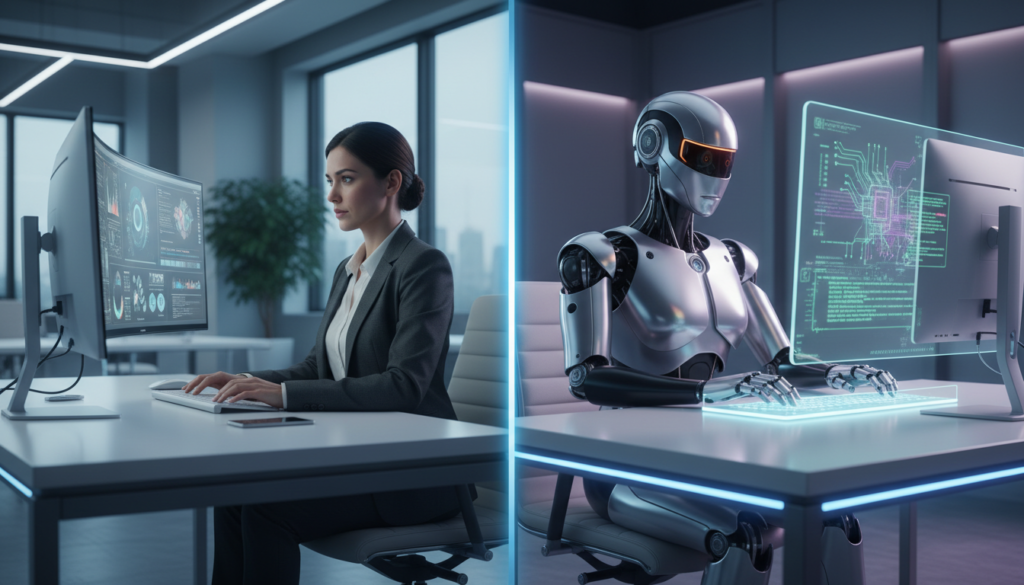
AI may replace tasks, but replacing full human roles is a much bigger challenge.
Some Jobs Will Change, Not Vanish
Let’s be honest—yes, some jobs will reduce.
Anything fully repetitive or rule‑based is at risk. But many roles will simply evolve rather than disappear.
A friend of mine works in digital marketing and was terrified when AI writing tools exploded. Instead of fighting it, she learned how to use AI to plan content faster. Now she gets more clients because her work is quicker and more polished. AI didn’t take her job—it upgraded it.
This will happen across many fields:
• Teachers using AI to create lesson plans
• Doctors using AI to analyze scans
• Designers using AI for quick mockups
• Programmers using AI for debugging
The people who learn to work with AI will grow.
The ones who ignore it may struggle.
Jobs That Are Hard for AI to Replace
Some roles are deeply human and unlikely to be overtaken anytime soon:
• Nurses, caregivers, therapists
• Skilled trades like electricians and plumbers
• Creative strategists and storytellers
• Managers, leaders, HR roles
• Jobs requiring physical presence and emotional intelligence
Think about it—would you trust a robot to care for your newborn? Or negotiate your salary?
AI can assist, but it can’t replace human empathy or intuition.
Jobs AI Might Reduce Over Time
Not all jobs are safe. It’s fair to acknowledge the areas where AI could take over more tasks:
• Data entry
• Telemarketing
• Routine customer support
• Basic graphic design templates
• Simple accounting tasks
But even in these fields, new roles are emerging, such as AI supervisors, AI content editors, prompt engineers, and automation specialists.

What You Can Do to Stay Ahead
Here are practical steps anyone can take:
• Learn the AI tools in your industry—don’t avoid them
• Build skills AI can’t easily copy, like communication and problem-solving
• Focus on creativity and decision-making
• Keep updating your knowledge every few months
• Stay flexible—careers change, and that’s okay
Even spending 10 minutes a day exploring AI tools can make a massive difference.
The Real Answer: AI Won’t Replace Humans—But Humans Who Use AI Will Replace Those Who Don’t
AI is not the enemy. It’s a powerful tool.
Think of it like calculators, computers, or smartphones. People who learned them succeeded. People who resisted got left behind.
AI won’t take all human jobs.
But it will change them.
And the people who adapt will be the ones who thrive.
If you treat AI as a partner instead of a threat, the future looks much brighter than you think.