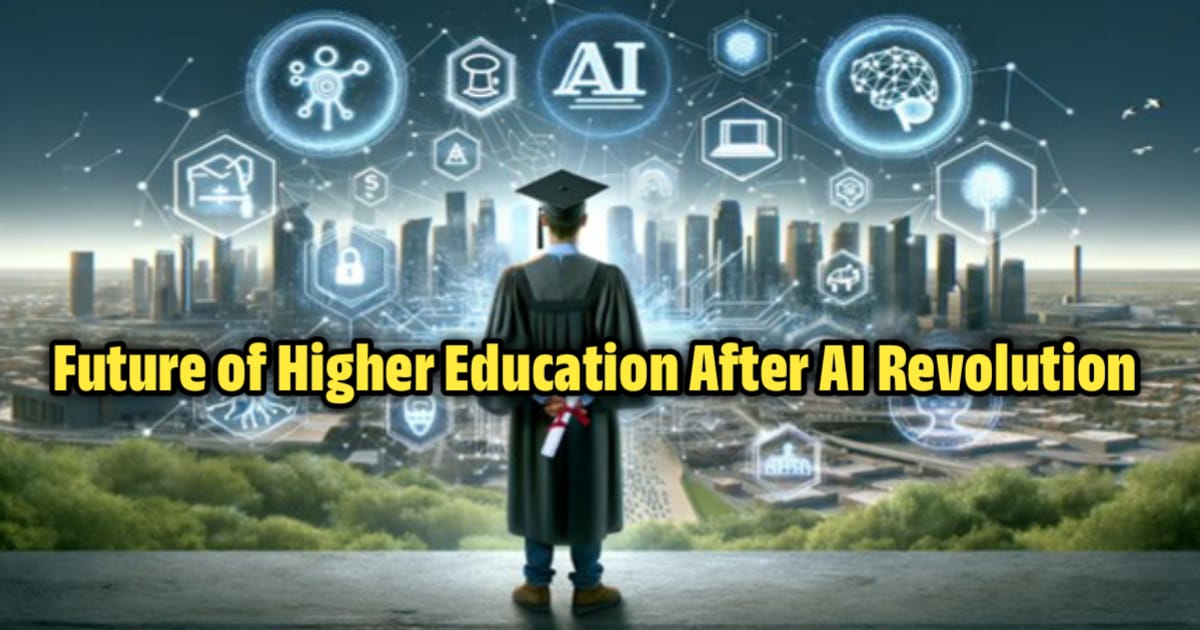
AI Revolution: The AI revolution is reshaping higher education by offering personalized learning, automating admin, and shifting assessment focus from knowledge recall to critical skills (like adaptability), but it demands new policies for ethical use, tackling the digital divide to prevent inequality, and redefining educator roles from content delivery to mentorship, balancing high-tech tools with essential human interaction. Universities will shift to dynamic portfolios, valuing practical capabilities (critical thinking, problem-solving) over traditional static transcripts as AI handles routine tasks.
What “AI Revolution” Mean for Higher Education?
The AI revolution refers to the rapid integration of advanced AI systems into knowledge work, creativity, decision-making, and automation. In higher education, this shift affects:
✔ Teaching and learning
✔ Research and discovery
✔ Credentialing and careers
✔ Institutional roles and economics
AI isn’t just a tool; it reshapes how knowledge is created, validated, and applied.
Key Transformations in Higher Education:
✔ Personalized Learning: AI tutors adapt content and pace to individual student needs, offering tailored feedback and interactive exercises, reducing learning gaps.
✔ Faculty Empowerment: AI handles administrative tasks (grading, planning), freeing teachers for higher-level mentoring, creative teaching, and deeper student engagement.
✔ Redefined Assessment: Focus shifts from essays/exams to portfolios demonstrating real-world skills (critical thinking, innovation) as AI can generate traditional answers.
✔ Streamlined Administration: AI improves efficiency in admissions, resource allocation, student support (chatbots), and data-driven decision-making.
✔ New Skill Focus: Curricula must evolve to teach digital literacy, AI ethics, and uniquely human skills like complex problem-solving and emotional intelligence.
Challenges & Considerations:
✔ Digital Divide: Unequal access to technology risks widening the gap between well-resourced and under-resourced institutions and students.
✔ Ethical Governance: Institutions need strong policies on data privacy, bias, and responsible AI use, notes.
Role of Educators: AI won’t replace teachers but redefine their role; human connection, motivation, and creativity remain crucial.
✔ Policy & Strategy: Universities must strategically plan AI adoption, not just react, to maintain relevance and public trust.
Professors & AI: Collaboration, Not Replacement
AI won’t replace expert faculty, but will shift their role:
What AI Can Do
✔ Provide instant feedback
✔ Generate practice problems
✔ Summarize readings
✔ Offer multilingual support
What Humans Still Own
✔ Ethical judgment
✔ Mentorship and motivation
✔ Deep domain reasoning
✔ Cultural and contextual nuance
Research Transformed: AI as a Scientific Partner
AI is already enabling:
✔ Faster literature review
✔ Data modeling at scale
✔ Automated experimentation
✔ Hypothesis generation
What Success Looks Like (Vision)
A future higher education ecosystem that is:
✔ Learner-centered instead of institution-centered
✔ Skill and evidence-based instead of time-based
✔ Human-AI collaborative, not competitive
✔ Accessible and affordable for global learners
✔ Ethically grounded in human values